

Accurate carbon analysis is becoming increasingly important for industries working with mixed fuels and emissions monitoring. Modern carbon analysers can determine the proportion of biogenic and fossil carbon by measuring Carbon-14, a naturally occurring isotope that indicates whether carbon originates from recent biological sources or fossil materials. Among the available technologies, the SCAR methode, and particularly the 14C SCAR approach, has emerged as a powerful alternative to traditional techniques such as AMS and LSC.
One of the most reliable ways to determine the renewable carbon content of materials is through Carbon-14 analysis. Biogenic materials contain trace amounts of this isotope, whereas fossil carbon contains virtually none. Measuring Carbon-14 therefore allows organisations to quantify the renewable fraction of their emissions with high accuracy.
This distinction is particularly relevant in Europe. Under many regulatory frameworks, biogenic CO₂ emissions are not subject to carbon taxation, whereas emissions originating from fossil carbon are. As a result, accurate isotope measurement can have a direct financial impact for industrial operators.
Several analytical techniques are available to perform this type of measurement, with the most widely used being Accelerator Mass Spectrometry (AMS), Liquid Scintillation Counting (LSC) and the more recent SCAR-based spectroscopy approach. Each method offers different advantages in terms of accuracy, cost and speed, making the choice of technique an important strategic decision for industrial users.
Understanding Carbon-14 and Renewable Carbon Content
Carbon-14 is a naturally occurring radioactive isotope of carbon. It is continuously formed in the atmosphere and incorporated into living organisms through the carbon cycle. As a result, recently formed organic materials contain small but measurable quantities of C14.
Over time, C14 decays. Fossil resources such as coal, oil and natural gas are millions of years old and therefore contain no detectable C14. This fundamental difference allows scientists and engineers to determine whether the carbon present in a material originates from recent biological sources or ancient fossil sources.
For industrial applications, this measurement is particularly valuable when analysing fuels derived from waste streams, such as refuse-derived fuel (RDF) or solid recovered fuel (SRF). These materials often contain a mixture of renewable biomass and fossil-based components such as plastics. By measuring the C14 content, the proportion of biogenic CO₂ emissions can be determined with high accuracy.
Why C14 Measurement Matters for Industry
The distinction between biogenic and fossil carbon is not merely academic. In many European regulatory frameworks, emissions originating from renewable carbon sources are treated differently from fossil emissions.
For industries such as cement production, which increasingly rely on alternative fuels, the ability to demonstrate the renewable fraction of fuel streams can significantly reduce reported fossil emissions. This in turn can influence compliance with EU climate regulations and reduce exposure to carbon taxation.
C14 analysis therefore provides an independent and scientifically validated method to quantify renewable carbon content. It allows companies to verify sustainability claims, improve transparency in emissions reporting and support broader environmental strategies based on life-cycle thinking.
Overview of C14 Measurement Methods
A number of analytical techniques have been developed to measure the C14 content of materials. The three most relevant approaches for industrial and laboratory use are AMS, LSC and SCAR-based spectroscopy.
Although all three techniques ultimately aim to quantify the same isotope, the way in which they detect C14 differs significantly. These differences influence their suitability for routine industrial use.
Accelerator Mass Spectrometry (AMS)
Accelerator Mass Spectrometry has long been considered the reference technique for measuring carbon isotopes. The method works by accelerating ions to extremely high energies and separating isotopes according to their mass. This allows individual carbon isotopes to be counted with exceptional precision.
Because of its sensitivity, AMS has historically been the preferred technique for applications such as archaeological dating and advanced geochemical research. The technique can detect extremely small amounts of C14 and is capable of providing highly reliable isotope ratios.
Despite these advantages, AMS is often less suitable for routine industrial analysis. The instrumentation is complex and expensive, sample preparation is time-consuming and measurements are typically carried out in specialised laboratories rather than directly within industrial facilities.
Liquid Scintillation Counting (LSC)
Liquid Scintillation Counting is another well-established technique used to measure radioactive isotopes, including C14 for carbon analysis applications. In this method, the radioactive decay of C14 produces beta particles, which interact with a scintillation fluid to produce detectable light signals.
LSC has been widely used in analytical laboratories because it offers a more accessible alternative to AMS for C14 analysis. The instrumentation is less costly and the technique is well understood within the scientific community.
However, LSC requires chemical preparation of samples and measures radioactive decay rather than the molecules themselves. This can introduce limitations in terms of precision and efficiency, particularly when large numbers of samples need to be analysed.
The SCAR-Based Approach
The SCAR method (Saturated Absorption Caviy Ring-Down) represents a more recent development in the field of isotope analysis. This 14C SCAR technique uses advanced laser spectroscopy to measure the molecular absorption characteristics of C14-containing carbon dioxide.
This optical approach allows for highly precise detection of C14 molecules directly in CO₂ samples. Because the technique measures molecular absorption rather than radioactive decay, it can provide rapid results while maintaining a high level of accuracy. As a result, the SCAR method is increasingly implemented in modern carbon analysers used for industrial C14 measurement.
For industrial applications, the SCAR method offers several practical advantages. Measurements can be performed much faster than with AMS, while operational costs remain significantly lower. At the same time, the analytical precision is generally higher than that achieved using conventional LSC techniques.
Comparing AMS, LSC and SCAR in Practice
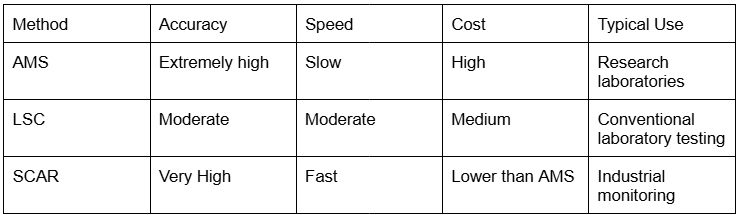
When selecting a C14 measurement technique, several factors must be considered, including accuracy requirements, analysis speed and operational costs.
AMS provides the highest analytical sensitivity but is typically reserved for specialised research environments due to its complexity and cost. LSC offers a more traditional laboratory method but may not provide the level of precision required for modern industrial applications.
The SCAR-based approach is designed specifically to bridge this gap. It combines high analytical precision with faster measurement times and more practical operating costs, making it well suited for industrial environments where routine C14 analysis is required.
For organisations analysing CO₂ emissions from waste-derived fuels or mixed combustion processes, SCAR technology can therefore offer an optimal balance between accuracy, efficiency and cost.
Industrial C14 Measurement Systems
Modern SCAR-based instrumentation has been developed to support industrial applications that require reliable and repeatable C14 measurements. These systems are designed to analyse CO₂ samples generated from combustion or fuel analysis processes.
One example is the 14C SCAR analyser developed by NCTechnologies, which is available in different configurations including the 4000 Series and the 8000 Series. These instruments are designed to provide rapid determination of the biogenic carbon fraction in industrial emissions or fuels.